Life As I See It: family

Showing posts with label family. Show all posts

Keeping Your Family Roots Intact Long After You're Gone

Thursday, January 5, 2023

 To forget one’s ancestors is to be a brook without a source, 
a tree without a root. 
— Chinese Proverb

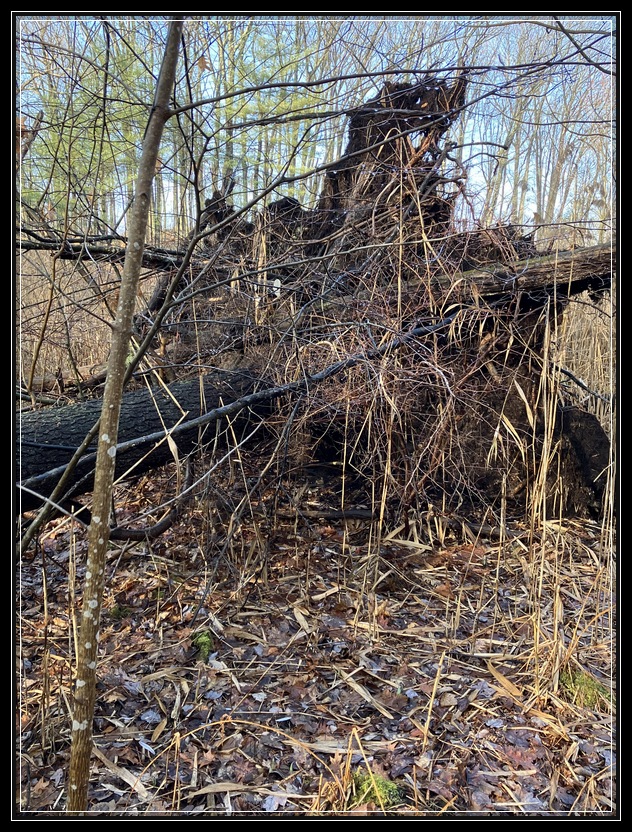
The land behind our house is part of a protected wetland, deemed forever wild. On either side of a stream there is a large portion of land that provides us with a view that changes dramatically with the seasons. At times we can barely see beyond our property line because the vegetation is so dense, but when autumn comes and the leaves drop, our view expands dramatically. In that view, I am able to see this fallen tree, roots still intact, some several years after it fell. On most days I look at the massive root base which sits like a giant roadblock in an otherwise open field, but the other day when I noticed it for the first time since the view opened up again, a different sentiment came to mind.


I'm not sure exactly when this tree fell, at least five years ago or more.  Although some parts of the top edges seem to be missing, it fascinates me that for the most part, it remains pretty intact, even after all this time.  From my perspective looking out the window, it's hard to be sure just how large the root base is (although the tree itself was quite tall and reaches far from its original spot to close to the edge of our property), so I sent John out, muck boots and all, to get a photo close-up.  I snapped a shot using my cell phone and was shocked to see by comparison (he's 5'8") just how large the root base actually is.

 If you've been reading my blogs for a minute, you know that my brain works in analogies and this was no different.  Almost immediately after noticing the still present, still intact root base, my mind began to churn.  That root base reminded me of family, specifically the strength of a family base.

This analogy perhaps originated from my genealogy research these past few years, along with my obsession with old family photos and the stories written in my Storyworth book.  Family and family history have always been important to me, but more so in the past few years.  When I look at the root base, I see large roots stretching in all directions....those are our early ancestors.  They are the origin of the family, its base.  From that base comes lesser roots, the next generations, followed by smaller roots- generations that follow.   Between the roots dirt is packed in, the roots hold it firmly so that even after years of being exposed to the elements of the seasons, it still remains mostly intact.  And among the roots and dirt, some new life, tiny vegetation takes hold and attempts to grow.  The dirt, for me, represents the health, the glue, of the family.


I think families are like this tree root.  Our ancestors are the basis for the family; they begin the whole process. How that process goes depends on many factors. For a tree, it depends on the soil conditions, the weather, wildlife....all of which can enhance it's growth or terminate it. Families are the same. They can be strong and sturdy or they can be weak and vulnerable. Unlike the trees in the forest who are at the mercy of the conditions that can't be controlled, families can be nurtured and preserved. When I look at this tree base I see a long lineage of a family, a family that has survived the generations, nurtured by love and support into a strong family unit. It's base (its history) remains long after it's uprooted, and long after its founding family are gone.

I think it's up to us, as keepers of our families and their history, to do what we can to make our base strong.  We need to intentionally work to keep our family stories alive through the generations.  We need to make sure the young people in the family know the people who came before them.  We need to make sure the young people in our family know the elders who are still with us and build those relationships.  We need to tell stories and share photos and celebrate our roots.   We need to honor our family history so that it will be strong and intact long after we're gone. I was fortunate to grow up in a family that valued family and the preservation of family history.  I spent many Sunday afternoons around my family dinner table listening to stories told by grandparents and great aunts and uncles.  I have boxes of family photos and memorabilia.  Those times, those artifacts, those memories are the glue that has kept our family together.  That is the 'dirt' that holds the roots, big and small, together.  It's the stuff that made me value how I got to be who I am today and the people who were here before me as well as those who were my support along the way, just like those tree roots.  I think that solid base is what kept my family strong, even during the storms.  I'm grateful for the people who came before me that were the dirt that held our family roots together.

I want to be like that giant root base, still a giant presence and foundational part of the family that remains long after I'm gone.  Don't you?  

History remembers the celebrated.  Genealogy remembers them all.
-Laurence Overmire


Did Anyone In Your Family Play a Part in History?

Saturday, April 23, 2022

 Not everyone has a claim to fame but lucky for me - I do. I’m able to say, “Leo Durocher is my third cousin.” Depending on who I say it to affects the reaction I get. People over 40 are typically impressed. Younger folks who don’t know Leo Durocher aren't all that impressed.  Although growing up I knew enough to carry this claim to fame with pride, I had no real sense of what a big deal Leo Durocher was, and honestly I wasn’t all that interested. I knew the basics - that he was a some sort of baseball legend. Not being much of a sports enthusiast, I will admit I didn’t take much interest in knowing more. Like most of my family history, Leo’s fame and accomplishments wouldn’t achieve their proper significance or impress me much until I was much older, specifically until I researched him for this question in a memoir prompt. What that translates to is the fact that it isn’t until now, in my 60's, that I realize how the “Durocher Gene” has endured and been passed down through the generations. I’m not talking about baseball.

Leo Ernest Durocher was born on July 27, 1905 to George and Clarenda (Provost) Durocher in West Springfield MA. He was the youngest of 4 sons. George, Leo’s father, was the son of Leon and Rosalie (Poutre) Durocher - parents of my great grandfather, Henry Durocher, of Cohoes, NY.  To help illustrate....that makes Leo my grandfather’s first cousin; my dad’s second cousin, and my third cousin. Here's my grandfather's brothers, George and Harry, in Florida with Leo in 1973.   

Leo’s father worked for the Boston & Albany railroad. His parents were both French Canadian and French was often spoken at home. Leo attended Springfield Technical High School but in 9th grade after a scuffle with a teacher, he got suspended. He quit school and never returned. He went to work for an electric company and played baseball for their company team. Unlike many of the shorter Durocher clan, Leo grew to be the tallest of his brothers reaching the grand height of 5‘10”. David Redd, a black man, encouraged Leo to try out for the Hartford ball team, a Yankee farm club.  Leo tried out but failed. In 1925, again encouraged by Redd, Leo tried again and this time Leo was successful. He made the team as an infielder. He showed so much promise, he was sold to the NY Yankees for $5000. After two seasons with the farm system, he got a permanent call to the big leagues in 1928. He won his first World Series that same year as a teammate of Babe Ruth, and another Hartford Senators alumnus, Lou Gehrig. He would become known as one of baseball’s fiercest and most successful players. 


As a captain of the St. Louis Cardinals, “Gashouse Gang” (named after Leo's fiery personality), in 1934, Durocher started shortstop and won another world series. After the 1938 season with the Cardinals, Durocher became the Dodgers player-manager and became known for his dirt-kicking tirades against umpires. He claims he was fired and rehired by the general manager dozens of times.

Leo's went on to manage the Brooklyn Dodgers (1939-1946), (1948), the NY Giants from 1948-1955, Chicago Cubs from 1966-1972 and Houston Astros from 1972-1973. 

Despite his antics, there was no doubt about his record. In 1941 Durocher led the Dodgers to the franchise’s first pennant in 21 yrs. Leo is quoted as saying, “as long as I’ve got a chance to beat you, I’m going to take it”. During the seasons of 1939 to 1941, 1943 and 1945, he served as a player-manager with the Dodgers and guided Brooklyn to two consecutive 100 win years (100 in 1941 and 104 in 1942), including the National League Pennant in 1941. Prior to the 1947 season, Jackie Robinson was placed on the Dodgers’ big league roster shattering the baseball racial barrier. Durocher made the point of telling his team that they accept Robinson as a teammate or else they would be traded. His message transcended baseball and in a way helped ease the entry of African-Americans into professional sports. Durocher himself would not manage the Dodgers during the 1947 season, due to a suspension imposed by commissioner Happy Chandler for allegedly associating with gamblers and allowing gambling in the clubhouse.

He left NY after the 1955 season to become a commentator for NBC baseball broadcasts. He returned to manage the Cubs in 1966 and served his final 9 seasons in Chicago and Houston. He retired in 1973 as the fifth winningest manager in history, second only to John McGraw in the National League, with 2008 career victories. He was named Manager of the year three-times (1939, 1951 and 1954).

Leo, known as Lippy and Leo the Lip, was known as a ‘win at all cost manager’. He coined the phrase, ‘Nice guys finish last’ and in one article I read he was described as ‘as brassy as the trombone section in a swing era band’. He was also called loud, profane, and charming when he wanted to be. Hmmm, that description might also describe some other Durochers I know. Edwin Pope who wrote Baseball’s Greatest Managers wrote about Leo with this quote, “Benefactor or blackguard, genius or jerk, paragon or prodigal, Leo Durocher was the most beguiling figure to walk through baseball.” Tommy Lasorda said, “I took his #2 because of love, admiration and respect. We lost a wonderful man.”

In 1965 he co-authored his autobiography, Nice Guys Finish Last. He spent his retirement years in Palm Springs, CA playing golf. He was married to Larraine Day, actress, and did a couple acting projects himself appearing in the Munsters, Mr. Ed and the Beverly Hillbillies. He appeared on What's My Line twice.  Leo passed away on October 7th, 1991 at 86 years of age. He was inducted into the National Baseball Hall of Fame in Cooperstown NY in 1994. John took my mom to the ceremony because my dad was laid up with heel spurs.  Some years later, John took me to visit Cooperstown to see Leo's plaque in person.

 Like some other Durochers I’m familiar with, Leo once said, “I’m a guy who has to do it my way, whether you like it or not.” Hmmm….the gene pool is pretty strong in this family.  Now I know where I get the 'attitude' from! 

Leo was not the best athlete to play baseball and some might not necessarily sing his praises but I'm particularly proud of Leo's contribution to paving the way to end segregation in sports. We recently watched the movie '42' about Jackie Robinson and seeing Leo (who was portrayed by Christopher Meloni of Law and Order fame) play such an instrumental role in Jackie's involvement with the Dodgers was a really neat thing to watch.  I’m no cooler by association when it comes to having someone famous in our family lineage, but I realized in researching Leo that despite my ignorance, he was a pretty accomplished and famous athlete as evidenced by the plethora of information that was generated in my Google search. It also makes me proud knowing that someone in my family was strong enough to stand up against segregation when it wasn’t the popular thing to do. It makes me wish I’d mustered up some interest years ago when my dad and great uncles who knew Leo could have told me more about him. At least now his history will live in my recorded history and hopefully my offspring will be proud to be related to such a legend.

Here's my grandfather with Harry & George....I think you can see the family resemblance....

Here is my Uncle George, playing ball for the Cohoes Orange Crush team in the late1920's...He didn't go on to play with the big leagues but he was a great man in many other ways.  


A story about Uncle George:  https://www.lifeasiseeitphotography.net/2014/11/a-tribute-to-special-veteran.html


Finding a Hero In Our Family Tree - Captain Michael O'Sullivan

Friday, May 21, 2021

 Michael M. O’Sullivan was born in Limerick, Ireland in 1808.  He married Catherine Howe in St. John’s Church in Limerick in 1829.  Michael and Catherine raised 6 children, Honora, Elizabeth, Michael, James, Catherine and Mary. He is my husband's third great grandfather.  Michael immigrated from Ireland and settled in Albany, NY.  This is his story.

Michael’s story came to us through a variety of sources, including his own words in letters now safely preserved at the NYS Military Museum in Saratoga Springs, from John's mutual ancestors’ family trees on Ancestry.com, and from various documents found on the web.  When I began my quest to explore our family ancestry, I had no idea what tales I’d find, but Michael’s story is beyond any expectation I hoped to uncover.  Let me tell you what I can about the multi-faceted Michael O’Sullivan. Photo of Michael courtesy of the New York State Military Museum in Saratoga Springs, NY.

In September 1870 when he was 62, Michael wrote a letter to Reverend Brother John Austin Grace of the Irish Christian Brothers School in Dublin, Ireland.  Michael O’Sullivan was a pupil of Brother Grace and his letter to Brother Grace is now preserved in the Brothers’ archives in Dublin.  Michael writes, “I am almost ashamed to write to you, after my having delayed so long to answer your letter.  The delay was occasioned partly by the death of my son and one of my daughters – the former died a year ago, leaving a wife and seven children, the latter died two years ago, within a year after her marriage.  My health is very much impaired – not by natural sickness but by the consequence of wounds I received during the late Civil War in this country.”

Michael goes on to tell that after his father’s death, he left Limerick in 1823 and went to Dublin.  “I bound myself apprentice to a mason, was at the finishing of the Revenue Docks in rere of the Custom House stores; worked in Belfast, Derry, Monagham, Tyrone, Donegal, Westmeath, Galway, Tipperary and Cork.  I prepared the first stone of the Donnybrook Bridge, attended the Marquis of Anglesea in laying it."  He writes, “I was a good stonecutter then, working at both trades as circumstances required.  I was selected by the late Very Rev. James O’Rafferty as Teacher of Tullamore National School, and was a member of the first class of teachers trained in Merrion St. Model School.  I conducted the school until 1840 when a combination, headed by some of the local Orange Magistracy, forced me to fly from Ireland.  My political opinions were at variance with those of the magistrates, and I freely exposed their doings in the Pilot, Athlone Sentinel and Carlow Morning Post.  Although never belonging to a secret society, I took every opportunity to shew my hostility to the petty tyrants who misgovern the country.”

 Michael and his family arrived in the United States in the early 1840's. He received his naturalization papers in 1855. For many years, Michael was a teacher in the different parochial schools in Albany – St. Mary’s, St. Joseph's, and St. John’s which some sources say he established.  One record also lists his occupation as catholic bookstore owner.   On October 7, 1859, a newspaper report states, “He  (Michael O’Sullivan) was brutally attacked by 3 assailants while leaving the Cathedral in Albany (Cathedral of the Immaculate Conception), with a daughter and her female friend between 11-12:00pm.  The newspaper reporter wrote, “the attackers should be imprisoned for life.”

Referring back to his letter to Brother Grace, Michael says, “Since I arrived in the US, I managed to obtain a respectable livelihood for my family until the war broke out in 1861.  I raised a company of 86 men, all Irish Catholics, without soliciting any of them to enlist, and without the aid of even one glass of intoxicating liquor, as I was then, and now and since 1834 a “Teetotaler” of the most rigid school.  My company being picked men, above common intelligence, moral and, I may say, religious, they were selected as vacancies occurred by the casualties of war, to be Lieutenants and Captains, and I had the pleasure of leaving the Regiment at the close of 1863, to see my place of Major filled by one of my recruits, John Dwyer from Co. Kilkenny. I was in 23 general engagements and skirmishes, the severest of which were “Fair Oaks, Antietam, the “Seven Day’s Fight (in which we fought 8 times in 7 days), Fredericksburg, Williamsburg, Gettysburg, Yorktown, etc.  I was shot thro’ the left knee which partially disables me, and after three months in hospital resumed my command, promoted Major and was invalided on a pension of $20 a month.  Since coming home, I have been employed in some of the State and US Departments, although frequently and seriously ill from the effects of my wounds.  Yet not withstanding all my trials, I am still robust and although 64 years old, my appearance is that of a man about 50, not even having gray hair.  The 63rd Regiment in which I served, formed part of the celebrated Irish Brigade,  commanded by the gallant soldier, the late Major General Thomas Francis Meagher, one of whose favorite officers I had the pleasure to be.  Our brigade had three Catholic Chaplains, Mass every morning, sometimes on the battlefield, surrounded by the dead and wounded; Rosary every evening and Confessions at any time, day or night.”  He goes on to say, “I am at present Clerk in the US Marshal’s Office and I go home to my little family every two weeks, to Albany, 150 miles up the Hudson River, spend Sunday at home and return to the office Monday morning.  I hope soon to write to you again when I will acquaint you with the state of Catholicity in the neighborhood of Albany at present, in contrast with 30 years ago - making Albany a centre, with a radius of 30 miles - and you will be astonished and thank God at the result."

In addition to being fortunate enough to have this letter from Michael, several of Captain O’Sullivan’s letters home from war appeared in local newspapers.  Without the experience of having served in battle, their vivid descriptions, and the stark reality of war – a war a relative participated in – bring light to a world most of us are fortunate not to have experienced.  Here’s some excerpts from some of those letters:

Captain Michael O’Sullivan of Company F, 63rd New York, in one of the few surviving accounts of the battle, described it to a New York newspaper:. “We have fought the enemy, and our company has either been killed or wounded, with the exception of eleven.”

Captain Michael O'Sullivan, Of Co. F, 63d Regiment N. Y. S. Y., who was wounded slightly in the leg, in the battle of Antietam, wrote home to Albany from the hospital at Keedysville on the same day, thus:

" We have fought the enemy, and our brigade has been cut to pieces! Every man of my company has either been killed or wounded, with the exception of eleven. I received a rifle shot in the left thigh, going completely through-fortunately without touching the bone. Poor Lieut. Henry McConnell was shot through the brain, and never spoke again. P. W. Lyndon, my First Lieutenant, was shot through the heart. Only one Captain (O'Neil) remained on the field. James De Lacey is killed-as also Tim. Kearns. Lieut. Sullivan, Terry, Murray, and the two Mahers, are all safe. Major Bentley is slightly wounded. Sergeant John Dwyer is wounded in the head. Sergeant Major Quick and M. McDonald are not touched. All the line officers of our regiment are either killed or wounded, save one Captain and five Lieutenants.

" * * * At this moment (10 A. M.) my wound is not yet dressed; but it gives me only slight inconvenience. I expect to leave here for Frederick to night, and from thence, probably, home for a season. Those mentioned above are the only Albanians of whom I have positive knowledge at this writing; but I will endeavor to account for them all."

 LETTER FROM CAPT. MICHAEL O'SULLIVAN, OF THE 63D REGIMENT-AN INTERESTING ACCOUNT OF THE BATTLES IN MARYLAND.-ON THE BATTLE-FIELD, SHARP'S FARM,

MARYLAND, Sunday, Sept. 21.
I am permitted once more to write to you. My wound is not as serious as I had anticipated, having bled a good deal, and at the time it looked very ugly, the bullet hiving gone through and through the fleshy part of my thigh, a few inches above the knee. It gives me no pain worth talking of, although the only dressing it has got, up to this time, is cold water, which I keep constantly pouring on it, day and night. This is in itself a great inconvenience, as I have not slept an hour at any one time until last night, when I got four hour's sleep, and awoke very much refreshed. I can scarcely move off my back, but I can very well afford to bear my situation with more than patience, when I look around the vast field and see poor fellows who are suffering from wounds, many of which are mortal- some shot through the head, back, groin, sides, shoulders and abdomen; others with lacerated limbs, and many, whilst undergoing amputation of legs and arms, shrieking and moaning in such manner as would penetrate the most obdurate heart.
I am laid near the Surgeon's quarters, and within one hundred yards and in full view of our Brigade burying-ground, in which fatigue parties are constantly employed burying the dead "uncoffined and unsung." Two groups of graves amongst the rest command my attention, and produce most melancholy thoughts in my mind. One, containing five mounds, rudely fenced in, in which are buried everybody's friend Lieut. McConnell, De Lacey, Kearns and Robbins, of Company K (Albany Co.); the other, containing the graves of Lieut. Lydon, Sergeant Gillespie, Corporals Kerrigan and Doherty, and private Madden, of my company (K)-upon whom, and all the other poor fellows, may the Lord have mercy!

Extracts from an Albany Officer's Private Letter.
HEADQUARTERS 63D REGIMENT, N. Y. V.,
CAMP CALIFORNIA, Va., Jan. 18, 1862.
“Oh! how solemn it is to hear the death dirge reverberating from hill to hill, in this wild country, and still more melancholy it is to see the mortal remains of a poor soldier, far from home and friends, placed in a hole (scarcely a grave), on which, it may be, "the foeman and the stranger" may tread in some future time. What a mockery is life, when it ends thus! The other day I was at the funeral of a fine young man who was accidentally shot by his own brother. To witness the distraction of the poor father and brother over the grave, was more than I could bear, and I was glad to escape from their wailings, although they mourned the lost one in German. May God give us the melancholy happiness to die among our friends, unless our lives are sacrificed in the path of duty on the field of battle!”

Michael O’Sullivan lived a rich life, filled with family he loved, fighting for a cause he believed in.  He went to war with his son at the age of 53.  He lied and gave his age as 45 when he enlisted.  A book written in 1899 by Myron A. Cooney about prominent people buried in St. Agnes Cemetery in Menands, NY, features a full-page story about Michael. 

 Mr. Cooney writes of Michael: “Even now in this city there are many middle-aged men who refer with pleasure and gratitude to his care of them in youth, his kindly counsel, and watchful guidance.  In 1865, July 4th, there was a presentation of NYS flags to Gov. Fenton and on this occasion, Captain O’Sullivan with his colonel, RC Bentley, represented the 63rd Regt, NYSV.  On account of his educational work in this city and his natural ability, he was connected with all the literary societies in this city from their inception, also with that of St. Vincent de Paul. St. John’s Institute presented him with a sword and revolver as a token of remembrance and esteem when he left for the seat of war.”
The article below is from 'Antietam on the Web':

After the war, Michael was a clerk of Criminal Statistics for eight years, until his death on February 21, 1873. His daughter, Catherine (Kate) died on September 8, 1856 at 21 years of age.  She and a younger sister were among the first members of the Cathedral choir.  At her funeral, Bishop McClosky (later Cardinal), preached, she being the only lay person for whom he did this service.  His daughter Elizabeth was named Executrix of his will.  He left her and his wife $20,000 (the equivalent of $400,000 today) to carry on his business.  Below is Catherine's tombstone in the St. Agnes Cemetery.

I am grateful for the work Michael’s second great grandson did to collect much of this story.  It is unlikely I, alone, would have been able to piece so many fabrics of Michael’s story together.  Thanks to Walter, John has a vivid picture of his 3rd great grandfather and the amazing life he led, giving so much of himself to others.  
If you've read this far, you may be thinking Captain O'Sullivan wasn't really a hero compared to so many heroes of today, and perhaps that's true.  I believe each of us has the ability to be a hero in some shape or form, that we have the ability to change lives for the better, to move people, to make the world a better place, not just in a big, showy way.  For us, finding an ancestor of John's that did all those things was a thrill and someone John is proud to call his Great, great, great Grandfather.  Isn't it time you began to search for the heroes in your family tree?
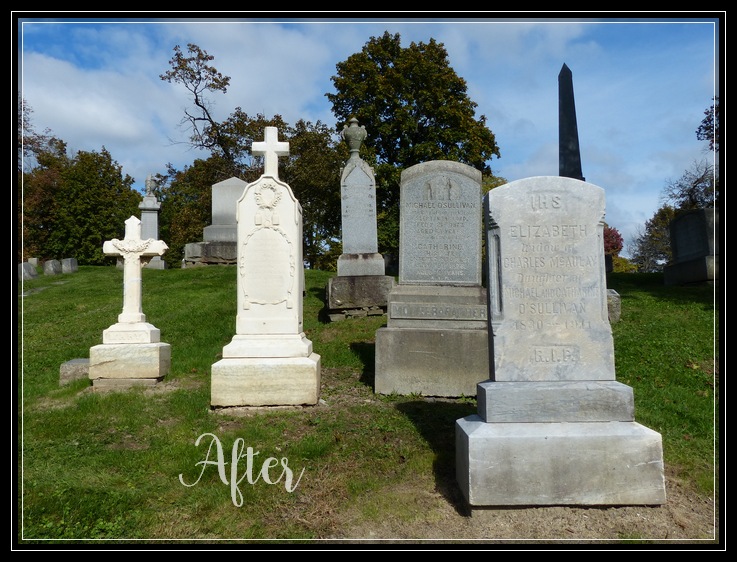
Post Script:  After discovering this family hero, John and I were inspired to fund some repair work to bring the O'Sullivan gravesite back to its original state.  Another of Michael O'Sullivan's ancestor, his second great grandson, Walt Kahnle, wanted to take part in the restoration and contributed to the project.  Michael's daughter Elizabeth's stone had a new base poured and her monument is not standing sturdily, as is Catherine's.  Her stone was also given a new base and then cleaned and the cross on top repaired.  His daughter Mary's monument was also given a new base and the cross itself was repaired and cleaned.  Now the whole family plot is sitting on the hill, sparkling and standing out from many locations in the cemetery.  To read more about St. Agnes cemetery, check out my post...https://www.lifeasiseeitphotography.net/2021/10/finding-solace-in-peaceful-resting.html


Searching Our Roots and Connecting With Our Past

Sunday, April 25, 2021

 There are two things we should give our children - one is roots and the other is wings.


The older I get, the more in touch I become with the balance of my future, the ever growing sum of my past and the importance of the people who came before me in shaping the person I am today.  The older I get, the more I love old relics, symbols of the past, possessions of those whose life is now just a memory.  I find myself wanting to be surrounded by these relics, partly because these days I've learned to value their history and wish I could share a conversation with their owners.  Somehow, the older I get, the nearer I get to my own final chapter, the more I'm drawn to the loved ones whose demise make it impossible for me to make a tangible connection.  

My recent photo project reminded me of the importance of documenting history.  It reminded me of days gone by and people I loved.  It reminded me that everyday, every moment we live and breathe, we are creating history.  We often forget that as we rush through life, we forget the legacy we are creating, a legacy that may or may not be tangible or memorable to those we leave behind.  I was reminded that there were people before me...not just my parents and grandparents, but parents and grandparents before them, people who left a legacy and more importantly created family that resulted in my being here today.  Who were those people?  Who came before my immediate family and what was their story?  I needed to know.


These questions led me to reactivate my Ancestry membership, a membership that previously only resulted in determining my DNA and the start of a very limited family tree.  I've been fascinated with the tv shows about finding your roots where it seems everyone finds some deep, fascinating secret or some wildly interesting, sometimes dark family member in the past.  I didn't have any delusions that I'd find any such person in my research, but it didn't matter.  All I wanted was an idea of who came before the relatives I'm familiar with, where previous ancestors came from and perhaps open a window to my family history. Some of what I discovered researching my family was not all that enlightening - or exciting - but when I began researching John's family, the plot thickened and the adventure began.  It was the discovery of his 3rd great grandfather that things got exciting and his story will be the subject of my next blog post.  Trust me, you won't want to miss it.  Still, there was some pretty interesting stuff to be found, stuff I'm sharing here today.

As we followed the family tree further and further back, we realized we weren't familiar with the burial spots of relatives beyond our grand and great grandparents.  Even then, some we hadn't visited in years.  This started the next process in our ancestry quest....locating and visiting all the local graves we could find.  Luckily, Findagrave.com helped us locate a bunch of family members, many of whom were in cemeteries we've already visited without realizing more family were buried there.  Others we visited for the first time.  This quest required a little detective work and a good deal of driving 'round and around the cemeteries trying to spot names on gravestones.  In all we visited five cemeteries including one out in Rensselaerville that turned out to have the wrong Fannie Bryant, not John's great grandmother, Fannie.  At each cemetery, I photographed the family gravestones and noted the location in the cemetery where we found them.  The oldest relative whose grave we found was John's third great grandfather who died in 1873 and his daughter who was buried near him in 1856.  They are laid to rest in St. Agnes cemetery in Menands - that cemetery is a story in itself and will also be featured here soon!  I've never been a fan of cemeteries or the idea of being in one, but I have to say visiting so many of our ancestors was a cathartic and grounding exercise.  It reminded me, though I never realized I needed reminding, that my story didn't begin a generation ago, or two generations ago.  It reminded me that there are stories and histories of those who came long before me and before the people I've met.

For instance, my grandmother spent her whole life living in Cohoes.  Her father came to the US from Canada in 1868 and her mom came from Scotland in 1869.  Her entire life was lived within a few blocks.  I knew the house she and my grandfather lived in until he died in 1963.  She then moved next door to an apartment and in the years prior to her death, she moved down the hill to 34 Hamilton Street.  It wasn't until I began collecting data from the 1900 census that I learned she was born and spent several years living in 36 Hamilton - the other side of the apartment building she lived in the last years of her life.  She began and ended her life in the same building!  How did I not know this??  


Johns great grandfather, Julius Welter, came to the U.S. from Germany in 1864.  According to the 1900 census, Julius was a plumber who lived at 6 Morton Avenue with his wife, Mary and six children, including John's grandfather Henry who at 15 was an apprentice nickle plater.  In 1913, he was admitted to the Albany County Almshouse at age 59 due to rheumatism. He died in 1920 and Mary, his wife, lived until 1922 with her daughter, son-in-law and their children.


Catherine O'Sullivan, daughter of Michael O'Sullivan, John's 3rd great grandfather, was among the first members of the Cathedral choir in Albany.  From a book published in 1899 by Myron Cooney "she was a general favorite and possessed a beautiful voice, and at her funeral, Bishop, afterwards Cardinal, McClosky preached, she being the only lay person for whom he did this service. The following inscription appears on her monument: "Memorial of the Cathedral Parish to Catherine O'Sullivan.  Died September 8th, 1956, aged 21 years.  Jesus be merciful."

Charles and Caroline Kraft, John's maternal great grandparents, immigrated from Germany in 1874.  On the 1920 census they were living on So. Pearl Street in Albany with 7 of their 9 children.  Notice if you can the age of the kids 47, 39, 37, 32, 29, 28, 22.  They worked in an ice house, a wholesale store, a shirt factory, a box factory, a knit mill, a bakery and a steam railroad.  Charles and Caroline were 72 and 66 and all of the kids are listed as single.  There has to be a story there......


My maternal great grandfather and grandmother, Michael and Mary, immigrated from Italy in 1883 and 1881.  In 1885 when Michael was 19, he was admitted to the Essex County Poorhouse.  The reason was sickness - dropsy (an old fashioned term for edema).  Later, Michael worked as a railroad section boss, and later as a laborer at a slate quarry in VT before going back to work for the railroad.  


They had 11 children. Their daughter, Lucy, died at 31 during childbirth.  Cause of death was listed as hemorrhage and Graves disease.  
Who would imagine these pieces of history could be found at the stroke of a keyboard, telling the history of your family members?  These stories, tragic but true, take me out of my every day existence and into the reality that people before me had dreams and jobs and sadness and struggles.  These stories put life to the photos that are left behind and put meaning into the freedom and conveniences we have today - even in things we take for granted like medical care.  This is just a tiny sampling of some of the things we learned from the records we found. We learned that back in the day, folks worked mostly in the local industries - the clothing factories and mills in Cohoes, the railroad in Mechanicville, wherever the work presented itself close to home.  Most of the women in my family spent their early years of employment in the Cohoes mills.  My great grandfather was a 'loom fixer'.   I learned that immigration isn't a thing just of the present - all of my great grandparents were immigrants...from Canada, Austria, Italy, and Scotland.  Almost all of John's are too, immigrating from Germany, Ireland and Luxemburg.   We are American, but inside we are a smorgasbord of nationalities, a melting pot of history and dreams.
We, in our world of convenience, a world of immediate gratification and living in the moment, need to take time to remember that life didn't begin with us.  It began a long time ago with people who struggled and worked and raised families - big ones - whose talents and dreams are in our genes.  They have stories, stories they aren't here to tell.  But thanks to modern technology, we can find their stories and relive their journeys through time.  We can get a glimpse of the family that made our lives possible.  It's in that not-so-secret past that we can meet those ancestors.  Then and only then can we retell their stories so that their legacy can live on in our children.  We can teach our children the importance of their history, their ancestors, the people who paved their way.  
I hope this inspires you to look into your past and find your roots.  It's addictive and fascinating and fun. In my next blog, I'll be sharing the story of Michael O'Sullivan - an Irish immigrant who came and left his mark and his legacy.  His story is incredible and impressive and one you won't want to miss.  
Thanks for stopping by!  Feel free to share your ancestry stories if you have them!


Preserving the Past For Future Generations Through Photos

Monday, March 29, 2021

 Printed photos.....remember those....before cameras became digital and all of our photos took residence on our computers and phones?  I'm old enough to remember printed photos.  In fact I come from a long line of serious history keepers and I think most of you know that the love of photography didn't skip my gene pool.  And that love, that passion, like most serious addictions, leads to a rather large collection of photographs spanning decades.


Growing up, our house was often the Sunday afternoon gathering place.  On many of those afternoons, after dinner, and sometimes after a holiday meal, the family would sit around the dining room table perusing photo albums, reminiscing about the 'good 'ole days'.   The stories flowed and memories were brought to life, sometimes repeatedly over the years.  I'm thankful for those times, those family members, who not only took the photos but so generously shared the history behind each one.  As an only child, only grandchild and in some cases, only niece, I have been fortunate enough to inherit a large collection of photos from both sides of my family, many dating back to the early 1900's.  My great aunts (who were married to my grandfather's brothers) were both meticulous when it came to recording who the photo subject was, the year it was taken and sometimes even the place it was taken.  Neither of these women had children, so that probably accounts for their attention to detail (and available time).  My mom also took a great many photos over the years, as did her sister and her mom.  Unfortunately they were less dedicated to labeling... which in some instances creates a bit of a mystery-solving task.    Then when I was old enough to be interested, I also jumped on the photography wagon. 

 My interest included both people and places and my passion for landscape photography and sunsets peaked in my early 20's.  Over the last 40+ years, I've acquired a rather embarrassingly massive amount of photos - not to mention all those I've inherited.  To my credit, I'll say that my collection was housed in albums, chronologically beginning in the late 1960's through about 2012.  My albums (over 20, each housing 100-200 photos) were packed with thousands of captured milestones and memories but also a lot of mediocre, repetitious or irrelevant photos.  Ya'll know what I'm talking about.  Those inferior shots that we kept after developing - because they were 'better than nothing', the kid looked too cute to not save the photo, or that shot that I took several versions of, etc... Then there was the box of photos that contained duplicates from the days of 'buy one set, get one set free', and the random photos that got plucked from their sleeve for some project and were never refiled.  So you've got the idea.....I've amassed a ridiculous collection of photos that needed some serious attention.  That's where the first project began.


Pippa found the entire process exhausting.

First I went through every album and plucked the photos that weren't worthy of saving - the dups, the blurs, the multiples, the squirrel at the birdfeeder, etc. Once I finished going through all those albums,  I was left with hundreds (not kidding, 100's) of empty spaces throughout every album. Next,  I sorted all the duplicate photos and photos that needed to be rehomed and organized them all by date. I then proceeded to re-file them in their appropriate album, and true duplicates were set aside for each of our girls to add to their own collections.  Once all the orphaned photos were filed or discarded, I still had hundreds of empty slots in all of the albums.  Literally, I threw away hundreds of photos.  The ocd in me couldn't possible live with albums with so many blank spaces so next I began the job of shifting photos forward, slot by slot, so that no empty slots remained. This task, though long and tedious, allowed me to eliminate at least 4 small (6" x 6") albums that held 100 photos and 3 larger albums that once held 200 photos that had ripped sleeves or broken bindings.  Two tattered albums were replaced with new albums. Eliminating these albums freed up a lot of shelf space.  Once that job was finished, I added a label to each album indicating the dates photos within included.  Looking for a photo now will be easy peasy.  You can see my assistants were not exactly carrying their weight.


The next portion of the photo project involved all the inherited photos.   I sorted these into piles of each 'family member' ....


and then scanned them onto my computer (you know, to join the bazillion of other photos that already live there).  I restored a bunch of faded or damaged ones and then filed them all by 'member'.  I then saved all the originals photos in envelopes I purchased on Amazon, labeled each envelope and tucked them all in a pretty storage box for quick and easy viewing (the old fashioned way).


I also bought large, zippered envelopes (also on Amazon) to store all the 5 x 7" and 8 x 10" photos I had tucked away....having swapped them from frames for more current photos, or tucked in my hope chest, or in closets. I labeled these envelopes too so now when I have random photos they can be easily filed in their appropriate place. I purchased scrapbooking storage boxes from Michael's for under $6.00. The bags fit perfectly and the boxes can stack on a shelf.

This was a huge project and I'm grateful that I had some help from John and the girls. Finally I have all the old, cherished ancestry photos sorted and scanned, filed and labeled and my photo albums are filled with only the best, most interesting photos.  Currently I'm exploring the family ancestry and when that is complete, my plan is to print photo books that will feature the old photos along with stories of those that came before me.  My only regret is that I didn't get this job done while relatives were still alive to answer questions and bring their photos to life.  If, like me, you have a sea of unattended photos tucked away in various drawers and boxes, now would be a good time to round them all up and get them labeled.  I'd give anything to know who the men with my Great Grandfather are in the photo below.  He's the man with suspenders sitting in front.  I have to believe this crew has a story or two!  Our photos, our stories, our memories are all we have of our life story and the story of those who came before us.  If you're lucky enough to be the owner of someone's story, it's up to you to make sure that story lives on for future generation.  One day someone will wish they knew your story....start writing it now.  


Well, I hope this inspired you to tackle this or some other project that's been looming. This was a big job, one I'm thrilled to have finished but I have thousands of digital files awaiting the same process. If you need me.....I'll be at my computer deleting and sorting digital files.


A Love Story for the Ages - Harriet and George Durocher

Monday, February 15, 2021

Valentine's Day.....not one of my favorite holidays, but I love what it stands for and when I think of what it stands for - LOVE, I'm often reminded of one particular love affair that stands out.  That is the love affair, the marriage, the partnership of my Uncle George and Aunt Harriet.  Theirs was romantic and enduring....lasting 64 years, until death did them part. 
I've told Uncle George's story here on the blog and it would be impossible to tell Harriet's story without sharing their incredible love story, so what better day to do that but Valentine's Day.  

Aunt Harriet was born in Cohoes, New York on June 9, 1911 to Robert and Harriet Ann Campbell.  Robert was an immigrant from Scotland who made a living as a loom fixer in the Harmony Mills in Cohoes.  He and Harriet were the parents of 8 children.  Young Harriet was the fifth born of those 8 children whose ages covered a 22 year span. When Harriet was 13 she became a victim of polio which had reached epidemic proportions in the US in the early 1900's.  Perhaps to lessen the risk of contagion and to provide better, one-on-one care, Harriet went to live with her oldest sister, Ruth, and her husband.  Ruth, then 26, was married to John King, an attorney in the city of Cohoes.  Harriet lived with her sister and brother-in-law for about a year of her convalescence during which time she recalled laying on an ironing board with weights on her one leg to encourage its growth.  During that year, she remembered her mother only visiting on a few occasions; her father visiting more often.  She assumed her mother was busy caring for her three youngest siblings who were 11, 9 and 4. 


Harriet recovered from her polio with a slight leg differential and an inability to conceive children but neither of those stopped her from living life to its fullest. Her sister Ruth paid for Harriet to attend business school, a privilege not available to many during that time. She made the most of her education landing a job as a Dictation Machine Transcriber for the NYS Department of Tax and Finance, in the late 1930's. She'd go on to be promoted to secretary to the Commissioner of Tax and Finance. He and Harriet retired in 1971. In her 90's, Harriet still made personal notes in shorthand.
Harriet and her boss at retirement party

I began this story promising a love story and that love story began when Harriet met my Great Uncle George (my grandfather's brother) in the early 1930's.  Uncle George was a quiet guy but excelled in speedskating and baseball.  He may have inherited that gene since Leo 'the Lip' Durocher was his second cousin. George and Harriet had a beautiful courtship and on November 16, 1935, they eloped.  It was during the Depression so after exchanging their vows, George and Harriet returned to their respective homes, keeping their marriage secret, so they could continue to help with finances.   Months later, they announced their news and moved out to begin their life as a married couple.

1935 Their Wedding Day


In 1939, George registered for the draft and in 1943, at the age of 36, George was drafted into the Army where he served in WWII in the Pacific Theater for three years.  Harriet did as so many women probably did during that time, she held down her job and maintained the homestead while George was off to war.  That may sound like an easy task, but it had its challenges.  Harriet didn't drive, or own a car.  She had to walk several blocks to take a city bus to Albany to work.  Often her walk home at night was in the dark, sometimes in challenging weather conditions.  She had to shovel coal through a window into the basement, where the coal stove for heating the house was.  Once her daily chores were done (hand washing, cleaning, preparing her clothes for the next day), Harriet ended her day - everyday - writing to her far away true love.  She recalled waking up in the morning, pen in hand, ink stains on her sheets. Three long years of this routine, I can't begin to imagine, but the time and distance did not diminish their love for each other. Theirs was a love I've not often seen or experienced.


George took hundreds of photos during his time away.  He'd write love notes on the back of them - all tiny prints about 2" x 3".  Harriet would do the same.  

 She'd share her everyday experiences, attest her love and assure George that their family members were taking care of her in his absence.  Finally George came home and their love story continued.  

In 1954, they built a small cape in Latham, NY.  George went to work for the Watervliet Arsenal.  Both George and Harriet loved to golf.  They shared household duties, inside and out and Harriet loved to share stories about things that most couples would consider mundane.  Her journals are filled with detailed descriptions of their weekends, who did which chores, Georgie making a delicious stew, how many geraniums they planted and other such activities which Harriet clearly relished as long as George was by her side.  After they retired, they'd lunch out most every weekday, either after golf or after chores.  Often they'd bump into George's brother, Harry and his wife, Antoinettte (Twin), who also dined out daily.  The four of them were very close; all of them wintering in Florida for many years.  George was quiet, much like my John.  I have such vivid memories of being at my parents home and George and Harriet would be there too.  George would begin telling a story and before long, Harriet would interrupt to add a detail and would routinely hijack the tale, as if it were her story to begin with.  George would just stay silent, sometimes playfully rolling his eyes until eventually Harriet would realize what she'd done - again. That realization would always result in her uproarious laughter at her own faux pas.  George never once displaying annoyance.  I think he enjoyed her version anyway.  

I don't remember them ever fighting but one day, probably when they were in their 70's or later, George needed to take the car for an oil change.  Harriet wasn't ready.  She had developed a habit of needing some coaxing.  Well George coaxed and prodded to rush Harriet, and that day, he had enough. He left Harriet home while he went for the oil change.  I'm not sure what the outcome of that consequence was, but I would guess it was more painful for George than Harriet and I'm doubtful it ever happened again.

Harriet lost her Georgie to lung cancer in February 2000.  All of us who knew and loved them, and knew of their deep and enduring love, worried that Harriet wouldn't be able to go on without him.  Their 64 year marriage was all she knew.  George was her rock, her best friend, her soul mate.  At 89, Harriet was tired and worn from the past months of watching her true love slip away.   The aides who had been helping them were not as reputable as we thought and my folks were not able to care for Harriet, so being ready for a change, I quit my job and picked up where Mom and Dad and the aides left off.

At first it was just a few hours Monday-Friday, doing chores, cooking meals, grocery shopping.  It was not my first experience with helping the elderly, but Harriet was definitely a dream to work for.  Sometimes people of that age can be cranky or fussy or nervous.  Not Harriet.  She was as calm as can be and so appreciative of every little thing done for her.  There was not a meal prepared for her that she didn't compliment.  "What a colorful meal" she'd say if her lunch happened to be a combination of colorful foods.  She savored and complimented every meal even if was something as simple as soup and a sandwich.  When she had regained her strength, once a week we'd go out to lunch.  Lunch didn't just involve eating.  For Harriet lunch meant a little shopping, a good meal and always, always dessert.  Harriet loved dessert.  I'll never forget this one day we were out to lunch.  As always, we ordered dessert, and on this day we ordered a slice of carrot cake to split.  Well, our carrot cake arrived and as the waitress made her way to us, every diner's eyes were peeled to our dessert as it was delivered.  Our cake, all 6 layers of it, was the size of a dinner plate!  We laughed till we cried over the massive, and undoubtedly calorie-laden dessert that cost more than either of our lunches.  

Another day we were sitting on Harriet's deck enjoying the early summer warmth.  I turned to go back inside to fix lunch when I realized the lock on her storm door must have been nudged on our way out and the door was now locked.  I immediately panicked.  I feared not only how she'd handle our predicament, but wondered how we'd get back in.  Harriet giggled and sat back, face to the sun, and just settled into her situation, unfrazzled in the least about her fate.  This would not be the last I'd witness Harriet's 'take life in stride' attitude.  Another day we were out for our weekly shopping/lunch outing.  We were driving through the Colonie Center parking lot when my cell phone rang.  This was before cell phones were common place.  My cell phone was an emergency phone; no one called unless it was an emergency and only a handful of people even had my number.  I pulled over and retrieved my phone from my purse in the backseat and answered.  It was my mom. It seems that Harriet had forgotten to do her weekly Lifeline check on her equipment so Lifeline had called to be sure Harriet was 'ok'.  When Harriet didn't answer, they assumed she must be on the floor unable to get up, or worse, and they proceeded to contact her 'first' emergency contact, her widower neighbor.  Bill dutifully unlocked Harriet's door and let the emergency personnel in to rescue their unresponsive victim.  Harriet was not unresponsive at all, in fact when she heard what was unfolding at her house, she laughed uncontrollably for a long time, stopping only to exclaim, "I'm glad we made the bed before we came out".  That was Harriet....never fretting or worrying.  Always seeing the bright spot in a situation.  Her mission was to savor life, every ounce of it.  And savor it she did.

One of our regular lunch destinations was the Scrimshaw Room at the Desmond Hotel and as much as Harriet loved fancy places like that and the Century House, she also loved more casual places like Friendly's.  There her favorite dessert was always a Happy Ending Sundae which she'd relish, as she carefully maneuvered long strands of drippy caramel into her mouth, rarely missing her target. She savored that like a gleeful child having a forbidden sweet.  Harriet loved her family, her friends and regularly kept in touch with so many.  For many years, George and Harriet attended George's annual reunion with his fellow war comrades.  Even when they were no longer able to attend, they exchanged cards and letters.  Harriet was a avid reader, loved Maeve Binchy novels especially, and loved PBS on tv.  She was a colorful storyteller.

Harriet was an expert seamstress and in her early adult years, she would order fabrics from New York City and make beautiful suits and dresses.  Her favorite magazine was Architectural Digest and though she lived in a tiny one-bedroom cape, she had fine taste in furniture and accessories.  She often made her own draperies.  George darned his own socks, a skill he learned while in the South Pacific when his soggy sock would wear thin.  She was also an avid gardener and tireless shopper.  Even in her 90's she loved buying new clothes.  Her favorite color was pink and when I once questioned why she buys so many pink tops, she answered, 'because as you get older, pink looks good and adds color to your complexion.'  She would sit in George's leather chair and roll her hair in pin curls - without using any mirror.  Her appearance never became unimportant to her.  When it became too difficult to do her own hair, she bought a wig.  Every morning before Harriet got out of bed, she did her morning stretches.  There were only two things in life Harriet couldn't do - complain and cry.  Even when George died, not a tear left her eye.  Her eyes would get red but not one drop would escape. Perhaps she used up her supply of tears those years when George was away in the war.  

I cared for Harriet for 5 years until it became necessary for her to have a higher level of care.  Again, Harriet accepted her situation and without whine or whimper, she moved into the same assisted living as her sister-in-law, Antoinette.  Later both of them moved to the same nursing home where Harriet lived to be 100.  Antoinette died a year later at 101.  I learned many things about and from these two ladies, too many to list.  Harriet, without being a perfectionist, was a role model when it came to doing what you love and doing it to the best of your ability.  I don't think I can point to anyone I know who embraces the joy of life more than Harriet. She harnessed joy, and happiness came naturally to her, or maybe she just wouldn't settle for anything less.  She focused on people's attributes and didn't acknowledge her awareness of anything beyond those.  She didn't sweat the small stuff but she embraced with open arms every big and little beautiful thing or experience life offered.  Perhaps it was her positive attitude that got her to 100.  


Twin, Leo Durocher, Harriet

Harriet and Jack Feeley (her boss) celebrating retirement

Self Portrait
My mom and Harriet, 2004

Harriet (l) Twin (r)
From their days as young women married to brothers, to the end of their days.....
Twin (97) and Harriet (96) in August of 2007


A love for all eternity.......George and Harriet......64 years of earthly love. 
Looking at her photos, Harriet's love of life is evident in every photo.  She was a shining example of confidence, style, enthusiasm, laughter (especially at herself) and a genuine embrace of all life had to offer.  Her love affair wasn't just with her Georgie, it was with everyone and everything life offered her and what more could any of us hope to achieve?

To read George's story:

and Twin's:


Life As I See It Header

Never Miss A Post - Follow by Email

Sign up here to get the latest blog post delivered to your inbox.
Never miss a post again!